The Peat Bogs of the Irish Midlands and the Salty Atlantic Breeze of Galway Bay: A Coast-to-Coast Span
Ireland rarely announces its transitions. The land shifts gradually, as if adjusting its tone rather than its terrain. From the peat-darkened centre of the island to the salt-washed edge of Galway Bay, the distance feels less like a crossing and more like an unfolding.
The midlands hold stillness differently from the coast. One absorbs sound. The other carries it outward on wind. Between them, fields stretch in subdued greens and browns, stitched together by stone walls and hedgerows.
Earth That Holds Its Own Weight
In the Irish midlands, peat bogs lie low against the horizon. The ground appears spongy in places, darker than surrounding fields. Water gathers in shallow pools that reflect sky in narrow bands. The air feels thick, though rarely heavy.
Footpaths run cautiously along raised sections. Grass bends gently, but the land beneath seems firm in its quiet way. The bogs do not present spectacle. They extend outward, textured rather than dramatic.
Many journeys west begin with the train from Dublin to Galway, leaving the capital’s Georgian symmetry behind for flatter stretches of countryside. Through the window, the bogland appears in segments — patches of brown earth cut by drainage channels, small clusters of trees interrupting the line of sight.
Cloud moves across the sky in wide sheets. Light shifts subtly across the peat, deepening its tone before lifting again. Nothing feels abrupt.
Wind That Carries Salt
Approaching Galway Bay, the landscape loosens. The ground rises slightly before meeting the Atlantic. The air changes first — sharper, edged with salt. Grass along the coast appears lighter, bent by wind that rarely rests.
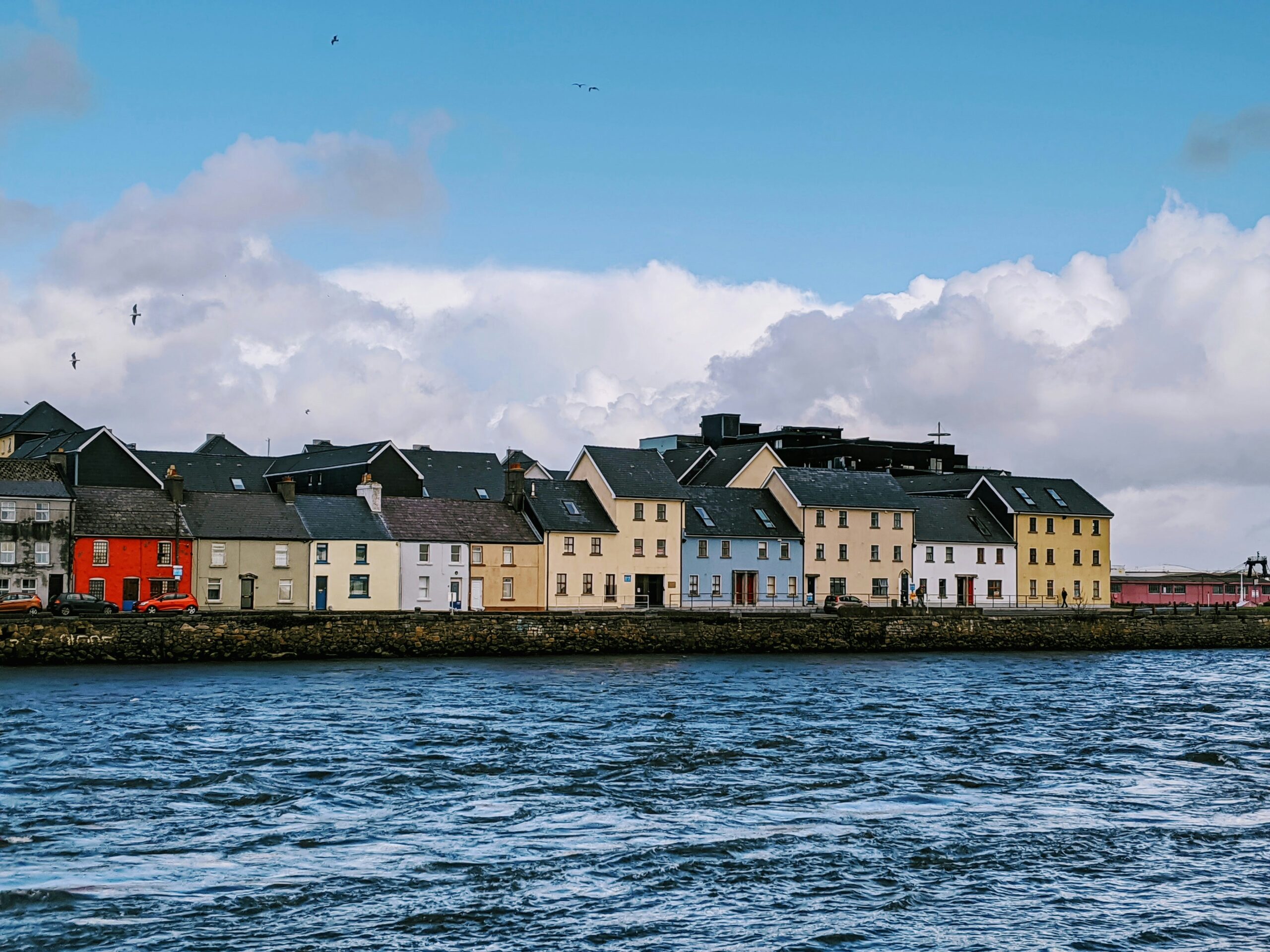
The bay widens toward open water. Boats sit low against the tide. Stone walls trace the shoreline in irregular curves. The horizon stretches farther here than in the midlands, the sky occupying more space.
Travel across such landscapes often recalls other rail journeys — the measured calm of a London to Oxford train, where countryside unfolds in restrained succession. In Ireland, the rhythm is similar, though the palette shifts from peat to sea.
Standing near the water, you sense movement even when waves remain small. Wind crosses open ground and carries distant sounds — gull calls, a door closing, faint conversation carried along the shore.
Ground and Tide
The peat bog absorbs. It holds moisture, history, and silence. Galway Bay releases. It reflects light and returns wind inland. One feels enclosed by earth. The other feels exposed to horizon.
Weather alters both in quiet ways. Rain darkens the bog further, softening its edges. On the coast, cloud lowers the sky until water and air appear to merge.
Inland, trees cluster modestly along hedgerows. At the coast, vegetation leans away from prevailing wind. The contrast is not dramatic; it is textural.
Between Centre and Edge
The distance between midlands and coast compresses into hours, yet the shift registers in small increments. Fields flatten before rising gently toward the west. Stone cottages appear sporadically, their roofs dark against green pasture.
Inside the train carriage, movement remains steady. Outside, bog gives way to pasture, pasture to shoreline. The progression feels continuous rather than segmented.
Memory tends to hold fragments — the deep brown of peat under a grey sky, the brightness of water catching late afternoon light. The two landscapes coexist without rivalry.
When Evening Draws In
As daylight lowers over the midlands, the bogland darkens into near-black, pools reflecting only faint traces of sky. Along Galway Bay, the sea deepens in colour, wind easing slightly as the tide shifts.
Later, recalling the span from centre to coast, the images layer softly — earth against water, stillness against breeze. The journey feels less like departure and arrival than like movement across gradients.
Nothing resolves into conclusion. The bog remains grounded. The bay continues to breathe with tide. Ireland holds both within its narrow width, bound by rail and road, carried beneath a sky that alters quietly from inland dusk to coastal night.