UK Bed Sizes Made Easy: How to Match Your Room Size Perfectly
 Here’s something that might surprise you – king size is the most popular bed size in the UK.
Despite measuring a generous 150cm x 200cm, it’s become the go-to choice for British homes across the country.
But here’s the thing about choosing bed dimensions – it’s not just about what you fancy. Your bedroom measurements should guide your decision, and that’s where many people get it wrong. Take a super king bed, for instance. Sure, it offers luxurious sleeping space, but you’ll need a minimum room size of at least 3.7 metres by 3.7 metres to make it work properly. That’s quite a commitment for most UK homes!
Whether you’re kitting out a tiny studio flat or designing a spacious master bedroom, getting to grips with different bed size options is essential before you buy anything. Picture this: cramming a king size bed into a small studio apartment when a small double would be perfect. You’d end up with a bedroom you can barely move around in.
So what’s the secret to getting it right? This guide will walk you through everything you need to know about standard dimensions, room size requirements, and simple measuring tricks that actually work. Plus, we’ll show you how different bed frame styles can completely change your room’s footprint, helping you create a bedroom that’s both practical and comfortable.
Understanding UK Bed Sizes
Getting your head around UK bed dimensions is absolutely crucial when you’re shopping for a new bed. This isn’t like buying a sofa where you can roughly estimate – bed sizes need to be spot on to ensure your mattress fits properly.
Single to Super King: Standard dimensions explained
UK bed sizes work their way up from smallest to largest, giving you six standard options to choose from:
Small Single beds measure 75cm × 190cm (2’6″ × 6’3″) and they’re designed primarily for children or those tiny guest rooms where every centimetre counts.
Single beds at 90cm × 190cm (3′ × 6’3″) give you enough space for one adult sleeper or growing children. These remain incredibly versatile – perfect for children’s rooms, guest bedrooms, or adults making the most of compact living spaces.
Double beds measure 135cm × 190cm (4’6″ × 6’3″) and were once the most common bed size in British homes. Here’s something that might shock you though – when two adults share a double, each person gets only about 67.5cm of space. That’s the same amount of room a baby has in a cot!
King size beds offer much more generous dimensions at 150cm × 200cm (5′ × 6’6″), giving you extra width and length compared to doubles. They’re both longer and wider than standard doubles, making them brilliant for taller individuals.
Super King beds measure 180cm × 200cm (6′ × 6’6″), offering the ultimate in sleeping space. Perfect for couples who value their personal space or families who love weekend morning cuddles with the kids.
What is a small double or queen size?
A small double bed (sometimes called a queen size in the UK) measures 120cm × 190cm (4′ × 6’3″). This can get confusing because a queen size in the US refers to completely different dimensions.
Small doubles sit perfectly between single and double beds, offering an ideal compromise for:
- Single adults who want extra space but don’t have room for a full double
- Teenagers who’ve outgrown their single beds
- Guest rooms where space is at a premium
- Small main bedrooms that can’t accommodate a standard double
As one manufacturer puts it, “You still get the same length with a queen bed that you would with a double at 190cm or 6’3″”.
How UK sizes differ from European and US beds
European bed dimensions generally beat UK measurements when it comes to length, typically measuring 200cm long instead of our standard 190cm. That extra 10cm makes European beds particularly brilliant for taller individuals.
The key European variations include:
- European Single: 90cm × 200cm (same width as UK single, but longer)
- European Double: 140cm × 200cm (wider and longer than UK double)
- European King: 160cm × 200cm (wider and same length as UK king)
US bed sizes use completely different terminology and generally run larger than UK options. A US king size is significantly wider than our UK king, and their queen size closely matches our king size dimensions.
Here’s something important to remember: mattress and bed frame names refer to standard dimensions, but the actual bed frame measurements will be slightly larger than the mattress size to accommodate it properly. Always check the total footprint of any bed frame you’re considering – it could make all the difference to how it fits in your room.
Getting your room size spot on

Choosing the perfect bed isn’t just about what catches your eye – your room dimensions are actually calling the shots here. You want to strike that perfect balance between having enough sleeping space and still being able to move around your bedroom comfortably.
Which bed fits in your room?
Each bed size has its own space requirements, and getting this wrong can leave you feeling pretty cramped:
A single bed needs roughly 2.1 metres by 3 metres to work properly. This gives you space for the bed plus essential bits like a small wardrobe without everything feeling squashed together.
Small double beds are brilliant for compact spaces – they’ll fit nicely in rooms around 3 metres by 3 metres, leaving you room for the furniture you actually need.
For a standard double bed, you’re looking at a minimum of 2.7 metres by 2.7 metres. Just bear in mind, this is really the bare minimum – add in a chest of drawers and things might start feeling tight.
King size beds need more generous proportions – at least 3 metres by 3 metres to function. Want it to feel properly spacious? Aim for around 3 metres by 3.6 metres and you’ll have a bedroom that feels balanced.
Super king beds are the space hogs of the bed world, demanding a hefty 3.7 metres by 3.7 metres minimum. For the ultimate in comfort and proportion, a room measuring 4.2 metres by 4.8 metres gives you breathing space.
How much wiggle room do you need?
Here’s where many people get it wrong – you need proper clearance around your bed for it to work in your space.
The golden rule? Leave at least 60-90cm of clear space around the sides and foot of your bed. This prevents that horrible cramped feeling and means you can actually make your bed without doing gymnastics.
Keep these essentials in mind:
- Give yourself minimum 60cm clearance on each side – your back will thank you when you’re changing sheets
- Check your bedroom door can open fully without hitting anything
- Think about wardrobe doors too – sliding doors can be a real space-saver if swing doors won’t work
Don’t forget, these clearance needs bump up your minimum room requirements. That 2.7m x 2.7m double bedroom? You’ll actually need more space once you factor in proper movement areas.
Making small bedrooms work harder
Small bedrooms have become the norm – the average main bedroom has shrunk from 165.7 square feet in 1930 to just 141.5 square feet today. But don’t panic, there are clever ways to make your space work harder:
Pick beds that earn their keep:
- Ottoman beds give you massive storage space underneath without needing extra furniture
- Divan beds pack in handy drawer storage while keeping a tidy footprint
- Children’s rooms? Mid-sleeper or bunk beds make brilliant use of height
Get smart with placement:
- Position your bed to catch natural light without blocking windows
- Floor-to-ceiling built-in wardrobes maximise every inch of storage
- Corner units turn awkward spaces into useful storage spots
Try before you buy:
- Mark out your bed’s footprint on the floor with masking tape – it’s a real eye-opener
- Always check the bed frame’s total dimensions, not just the mattress size
- Remember, bed frames typically add 5-15cm to mattress measurements
Getting your bed size matched to your room creates a bedroom that feels just right – not too cramped, not too empty. When you’ve got the proportions spot on, you’ll have comfortable movement space plus room for all your essential bedroom furniture.
Getting your measurements spot on
You know what separates a bedroom that works from one that doesn’t? Accurate measurements. Take the time to measure properly now, and you’ll save yourself from delivery nightmares and that sinking feeling when your dream bed simply won’t fit through the door.
How to measure your room like a pro
Getting precise measurements isn’t complicated, but it does require a bit of method:
- Clear everything out of the room first – you need unobstructed space for accurate measurements.
- Get yourself a decent tape measure – the retractable type works best for longer distances.
- Measure the width from wall to wall. Got alcoves? Always measure at the narrowest point.
- Record the length from one end to the other.
- Don’t forget ceiling height if you’re thinking about bunk beds or loft options.
- Mark down any fixed obstacles like built-in wardrobes, windows, and radiators.
- Check that doors can still open properly once your bed’s in position.
- Measure everything twice – trust me, it’s worth the extra five minutes.
Here’s something people often forget: measure your delivery route too. Check doorways (width, height, and diagonal), hallways, staircases, and any tight corners. For stairs, measure the shortest distance from the bulkhead to the nearest step – this measurement determines what you can actually get upstairs.
Try the masking tape trick
Want to really visualise how your bed will look? Masking tape is your friend. Start with a quick floor plan on paper, then transfer those dimensions to your actual room.
Simply tape out the bed dimensions on your floor. This gives you and your family a real sense of how much space the bed will actually take up. You can walk around it, test different positions, and see exactly where your walking paths will be.
The beauty of this approach? You can easily shift the taped outline by a few inches to test different positions – something that’s impossible to judge from drawings alone.
Don’t make these measuring mistakes
The biggest mistake? Guessing your room size instead of measuring it properly. A bed might look perfect in your head until you realise you can barely squeeze around it.
Watch out for these other common slip-ups:
- Forgetting to measure doorways and staircases
- Missing storage drawer extensions – add the full drawer length to your measurements
- Not checking diagonal doorway measurements, which can often squeeze larger items through
- Overlooking where your existing furniture will go – bedside tables and wardrobes need space too
- Choosing style over sense with beds that are simply too big for the room
Remember, bed frames always extend beyond the mattress size – especially styles with chunky side rails or elaborate headboards.
Which bed frame style will work best for your space?
Your bed frame choice does more than just hold your mattress – it completely changes how much floor space your bed actually takes up. Often, the frame extends well beyond those standard mattress dimensions you’ve been planning around.
Divan vs ottoman vs sleigh beds
Divan beds keep things simple with a sturdy base wrapped in fabric. These practical frames work brilliantly for space efficiency, offering storage through integrated drawers whilst maintaining a compact footprint. Divans arrive as pre-made box bases, making them remarkably easy to assemble. Because they sit close to the floor, they’re perfect for smaller rooms where every centimetre counts.
Ottoman beds take a different approach with their clever hydraulic lift mechanism – the entire mattress base lifts up to reveal a spacious storage compartment underneath. You get substantially more storage than divans because you’re using the complete area beneath your mattress. These work particularly well in narrow bedrooms where side-opening drawers simply wouldn’t be practical.
Sleigh beds bring drama to your bedroom with their curved headboard and footboard that resembles a sled. They make beautiful statement pieces, but remember – this design extends your bed’s footprint significantly at both ends. You’ll need extra clearance beyond the standard mattress dimensions.
How frame style affects total footprint
Different bed styles impact your room’s layout in various ways:
- Standard divans add minimal extra width and length to mattress dimensions
- Space-saver beds can actually reduce your overall footprint by up to 8cm in width and 12cm in length
- Sleigh and four-poster beds substantially increase the total footprint due to their decorative elements
- Ottoman beds match standard dimensions but need clearance space above for lifting the mattress
Some space-saver designs get really clever – they let the mattress rest on top of the wooden frame instead of within it, condensing the overall dimensions. This approach means you can fit larger mattress sizes into tighter spaces.
Storage beds and space-saving options
Room feeling a bit cramped? Storage beds give you dual functionality. Ottoman designs offer maximum storage capacity because you’re using the entire under-bed area. Divan beds with drawers provide more accessible storage without the need to lift your mattress.
For particularly compact spaces, consider these specialised options:
- Low platform beds for rooms with slanted ceilings or dormers
- Cabin beds with elevated sleeping areas and storage or desk space underneath
- Stacker or trundle beds for occasional guests
- High beds that make the most of vertical space in smaller rooms
Don’t forget – storage beds with drawers need sufficient clearance space for the drawers to open fully, which adds to their functional footprint. Factor this into your room measurements before you buy.
What else should you think about before you buy?
Getting the bed size right is just the beginning. There are a few practical things that can make or break your bedroom project if you don’t plan for them properly.
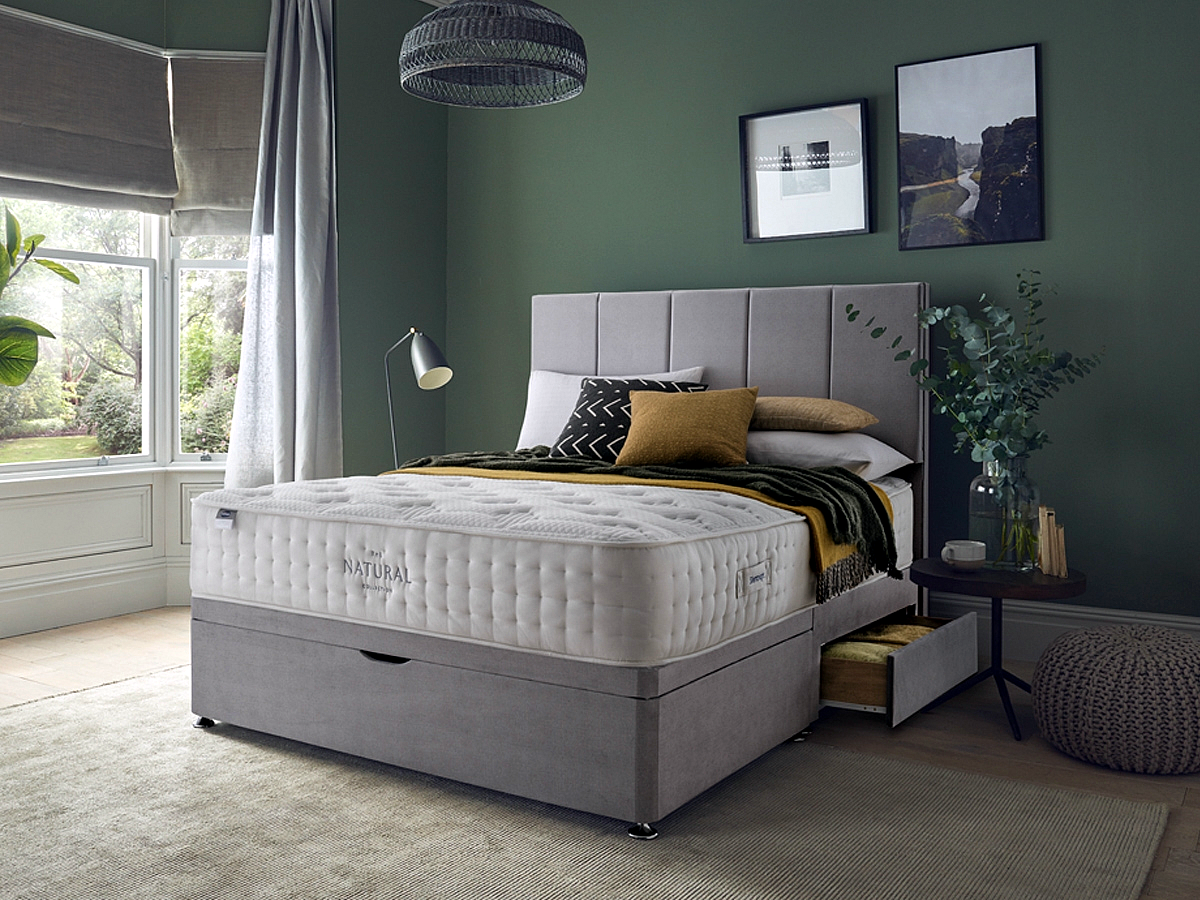
Pictured: Silentnight Puriel Natural 1400 4FT 6 Double Divan Bed. Available from www.bedstar.co.uk.
Mattress depth and your bedding
Here’s something most people don’t think about until it’s too late – mattress thickness varies massively, anywhere from 8 to 20 inches deep. This doesn’t just affect how comfortable your bed feels, it completely changes what bedding you’ll need.
Standard fitted sheets work fine for mattresses between 20 to 35 cm deep, but if you’ve got something thicker, you’ll need extra deep fitted sheets designed for mattresses between 38 to 46 cm thick.
Don’t forget about mattress toppers either. Even a thin one can push your mattress depth over the edge, meaning your lovely new sheets won’t fit properly. It’s one of those annoying discoveries you make at 11pm when you’re trying to make the bed!
Getting it through your door
This is where many people come unstuck. Before you fall in love with that perfect bed online, check every route it needs to take through your home:
- Doorway width and height
- Staircase clearance (especially the distance from bulkhead to steps)
- Any awkward corners that need extra wiggle room
Narrow stairwells or sharp corners making you nervous? Look for split-base options that come apart for easier delivery and assembly. Or consider those clever boxed mattresses that arrive compressed and rolled up – much easier to manoeuvre upstairs.
Planning for what’s coming next
Think about how your sleeping needs might change. Growing families often find little ones appearing during thunderstorms or bad dreams. Regular guests staying over? Flexible options like guest beds give you versatility without needing a whole spare room.
And here’s something worth considering as we get older – larger beds often become more important for comfort, especially if joint issues or mobility concerns develop. Better to plan ahead than wish you had more space later.
Getting your bed size spot on
You know what? Getting the right bed size really does come down to balancing what you want with what your room can actually handle. We’ve covered everything from compact single beds right up to those luxurious super kings, and the key thing to remember is that your choice needs to work for both your sleeping comfort and your room space.
The measuring bit might seem like a chore, but trust us – it’s worth doing properly. Grab that tape measure and take your time with the measurements. That simple masking tape trick we mentioned? It’s a game-changer for visualising how your new bed will actually sit in your space. And don’t forget to think about the whole bed frame, not just the mattress size.
Different bed styles really do make a difference to how much floor space you’ll need. While divans keep things compact, those gorgeous sleigh beds need quite a bit more room to work properly. Storage beds are brilliant for smaller spaces, but you’ll need to factor in the space for drawers to open or ottoman lids to lift.
Here’s something many people forget – check that delivery route before you buy anything. Even the perfect bed isn’t much use if it can’t get up your stairs! Think ahead too. Will you have guests staying over? Kids who might want weekend morning cuddles? Your needs might change over time.
Takeaway Tip: The perfect bed creates a bedroom that feels balanced – comfortable to move around in while making the most of your available space.
Armed with all this knowledge about UK bed sizes and room requirements, you can choose a bed that’ll work beautifully in your space for years to come. Sweet dreams!